


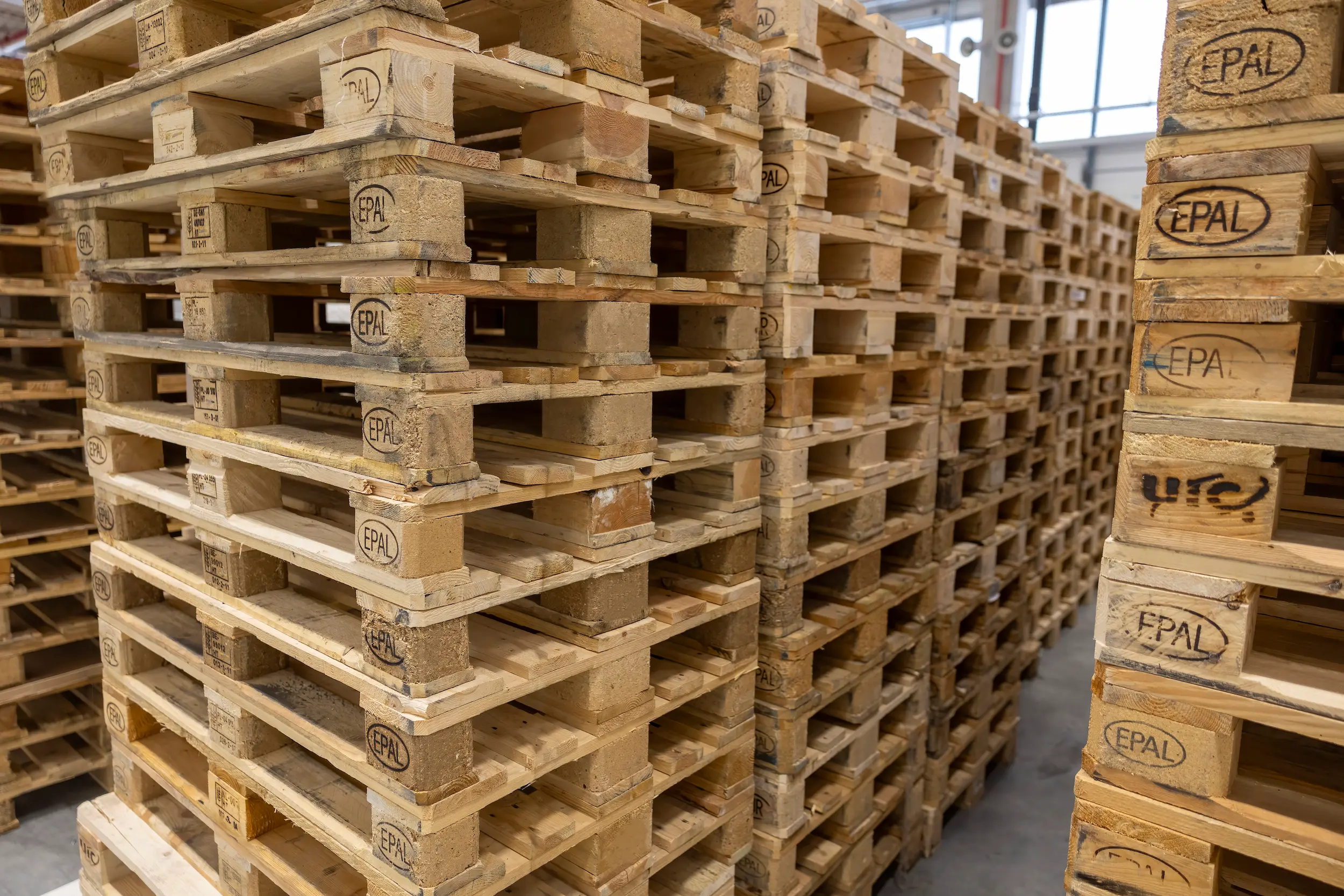

How high is the deposit for euro pallets?
Anyone who works with euro pallets cannot ignore the issue of deposit. But how much is the deposit actually — and why do the amounts differ so significantly from company to company? Many shippers, carriers and recipients have different values, although there are actually fixed quality standards for EPAL pallets. To ensure that costs remain transparent and pallet movements can be calculated cleanly, it is worth taking a closer look at the usual deposit rates and the factors that influence them.
How much deposit is calculated for a euro pallet?
In practice, the deposit value for a euro pallet is usually between 10 and 15 euros per piece. This amount has become established across industries because it represents the average replacement value of an exchangeable EPAL pallet.
Depending on the partner company, industry or contract model, the values may fluctuate slightly:
- Food trade & industry: often 10—12 €
- Wholesale & production: often 12—15 €
- Disposable or damaged pallets: sometimes significantly lower
Important: The deposit does not correspond to the real one Price of a euro pallet, but serves primarily to secure economic value in the exchange system.
Factors that influence the deposit value
The deposit amount differs depending on the company.
Whether a euro pallet is valued at €8, €10 or €15 depends on several practical factors. Although the EPAL standard clearly defines the technical requirements, market conditions and individual agreements determine how high the deposit actually is. The most important influencing factors are:
- Pallet condition: new, as good as new, replaceable or repaired
- Timber prices & market availability: high demand = higher deposit rates
- Sector & exchange partners: retail, industry, freight forwarders have different standards
- Contractual regulations: framework agreements or individual pledge agreements
- Euro pallet pooling vs. exchange system: In pooling, there are often fixed rates, in exchange for more variability
These factors mean that deposit prices are rarely the same everywhere — even if the pallet is technically identical.
Why deposit and real market price are not the same
The deposit amount of a euro pallet does not cover the real market value — it is simply a security value that secures the exchange process.
While the real price fluctuates significantly depending on the condition, timber market and retailer, the deposit deliberately remains lower and more stable so that pallet movements can be handled easily and fairly.
Typical comparison:
- Deposit value: approx. 10—15 €
- New market price: approx. 10—22 €
- Used market price: approx. 5—18 €
The deposit is therefore a logistical instrument, not a reflection of the actual value of the goods.
How does the pallet deposit work in the exchange system?
The deposit amount plays a central role in the exchange system: It ensures that every euro pallet issued is economically balanced — either by returning it or by means of a corresponding credit note. As a result, the pallet inventory between shippers, freight forwarders and recipients remains permanently in balance.
In practice, this means: The sender hands out pallets and receives the deposit value credited upon return. Replaceable pallets are replaced 1:1, while damaged pallets must either be repaired or fully invoiced. Every movement is documented using pallet slips or exchange receipts so that inventories can be traced at all times. If there are open pallet balances, this is usually due to the fact that fewer pallets were returned than originally issued — a risk that minimizes the deposit system and at the same time ensures clear, transparent inventories in the daily movement of goods.
Frequently asked questions about the deposit for euro pallets
Do I automatically have to pay a deposit for every euro pallet?
No Deposit is only charged where companies work in an exchange system or cannot return pallets directly 1:1. Many industrial and pooling processes function completely without deposit.
Why do deposit amounts differ from company to company?
The deposit value is not regulated by law. It is based on agreements between partners and depends, among other things, on condition, availability and individual industry standards.
What happens if a returned pallet is damaged?
Damaged pallets are often considered irreplaceable. They must be repaired, replaced, or fully calculated. The deposit value is not refundable in such cases.
Is there also deposit on mesh boxes or attachment frames?
Yes Depending on the condition and industry, mesh boxes and attachment frames have their own deposit rates, which are usually higher than for euro pallets.
Is the deposit value the same in all countries?
No The amounts vary by country, industry and partner. While the EPAL range is standardized across Europe, deposit prices are purely market agreements.
Is the deposit always refunded in full when returned?
Only if the pallets are exchangeable. Non-exchangeable pallets are often only partially credited or must be replaced.

