



What are butcher crates? Design, use and differences explained
Whether in a butcher shop, in a slaughterhouse or in refrigerated transport: butcher crates are part of daily practice in food processing. They enable the safe, hygienic and efficient handling of meat products along the entire supply chain. As standardized reusable boxes, they are designed for repeated use and can be easily integrated into existing storage and logistics systems.
What do you understand by butcher crates?
Butcher crates are standardized reusable boxes made of food-grade plastic, which have been specially developed for the transport, storage and processing of meat and meat products. They meet high hygienic requirements and are designed to be used several times in professional use.
Butcher crates are characterized by their uniform dimensions in accordance with European standards, which enable smooth integration into existing storage, conveying and transport systems. Thanks to their sturdy construction, smooth inner surfaces and their resistance to moisture, grease and cleaning agents, they are particularly suitable for use in butchers, slaughterhouses and the food industry.
In contrast to conventional plastic crates, butcher crates clearly focus on hygiene, cleanability and food safety.
What are butcher crates used for?
Butcher crates are used wherever meat and food must be transported or stored hygienically, safely and efficiently. Thanks to their robust construction and standardized dimensions, they are suitable for use along the entire process chain — from processing to delivery.
Used in butchers and butchers
In artisanal butchers, butcher crates are used to store fresh meat, cuts and processed products. They facilitate internal work processes, are stackable and are easy to clean after use.
Use in slaughterhouses
Butcher crates are used in slaughterhouses and cutters to safely transport meat parts between individual production steps. Their food safety and cleanability are essential for compliance with strict hygiene guidelines.
Use in the food industry
Butcher crates are also used in industrial food processing — for example for processing, interim storage or order picking. Thanks to their standardized dimensions, they can be easily integrated into automated conveyor and storage systems.
Use in logistics and refrigerated transport
In the logistics sector, butcher crates are used for the refrigerated transport of meat products. They are compatible with euro pallets, withstand low temperatures and contribute to the stability of the cold chain.
Difference between E1, E2 and E3 crates
E1, E2 and E3 crates are standardized versions of butcher crates. The term Butcher crates serves as a generic term for standardized, food-safe plastic crates that have been specially developed for use in meat processing.
The terms E1, E2 and E3 come from the Euronorm system and do not differ in material or function, but mainly in height, volume and typical area of application.
E1 boxes — flat and handy
E1 crates are the lowest version of butcher crates. They are particularly suitable for smaller pieces of meat, portions or products that are frequently moved manually. Due to their low height, they are easy to handle and are often used in butchers or for short internal transport routes.
E2 crates — the standard among butcher crates
E2 crates are the most widely used form of butcher crates. They offer a balance of volume, stability and handling and are used throughout meat logistics — from processing to storage to transportation. In many companies, E2 boxes are considered a standard solution.
E3 boxes — more volume for larger quantities
E3 boxes are higher than E1 and E2 boxes and are used when larger quantities of meat or larger pieces of meat need to be transported or stored. They are used primarily in slaughterhouses, cutting plants and in industrial food processing.
Classification in connection with butcher crates
In summary, the following applies:
E1, E2 and E3 crates are different types of butcher crates.
All variants meet the same basic requirements for hygiene, food safety and reusability. The choice of the right crate depends on the respective area of application, the product size and the logistical requirements.
What are the dimensions and standards of butcher crates?
Butcher crates are standardized in accordance with European standards and tailored to the requirements of food and meat logistics. The standardization ensures that the boxes can be easily integrated into existing storage, conveying and transport systems and are optimally compatible with euro pallets.
European standard as a basis
The most common butcher crates are based on the Euronorm basic dimensions of 600 × 400 mm. This standard is established across industries and enables efficient palletizing, automated conveyor technology and space-saving storage.
Typical heights of butcher crates (E1, E2, E3)
The distinction between E1, E2 and E3 boxes is based primarily on the height and therefore on the usable volume:
- E1 boxes: approx. 125 mm height — suitable for smaller quantities and pieces
- E2 crates: approx. 200 mm high — the standard in meat logistics
- E3 boxes: approx. 300 mm high — for larger quantities and larger pieces of meat
All variants have the same floor space (600 × 400 mm) and can therefore be easily combined with each other.
Compatibility with euro pallets
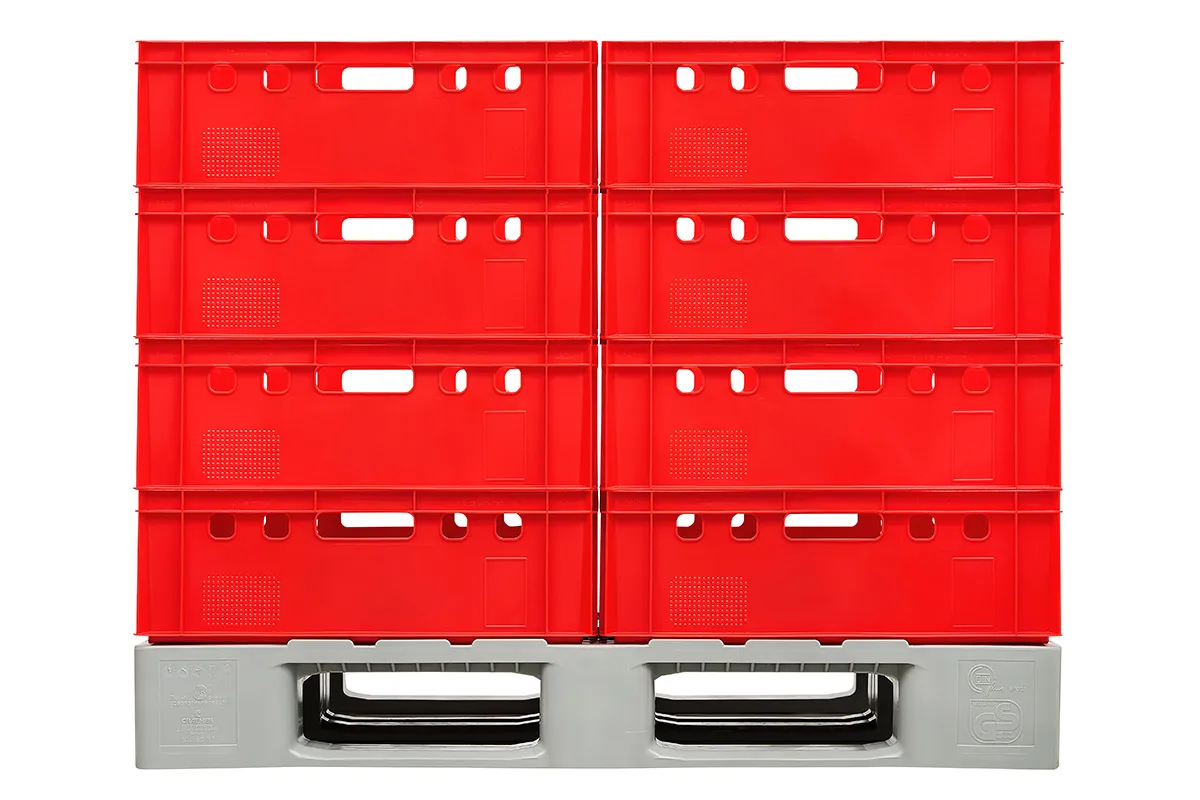
Thanks to the Euronorm format, butcher crates can be efficiently stacked on euro pallets (1,200 × 800 mm). There is usually space for four butcher boxes per layer, regardless of whether they are E1, E2 or E3 boxes. This makes transportation, storage and picking much easier.
Other standard-relevant properties
In addition to the dimensions, butcher crates meet other important standard requirements:
- food grade plastic
- smooth inner surfaces for easy cleaning
- resistance to moisture, grease and cleaning agents
- temperature-resistant for refrigerated and deep-freeze areas
What material are butcher crates made of?
Butcher crates are usually made of high-quality, food-grade plastic such as polyethylene (HDPE) or polypropylene (PP). These materials are approved for direct contact with food, do not absorb odors or liquids and meet high hygiene, stability and durability requirements. Thanks to their smooth surfaces, butcher crates are easy to clean, are resistant to grease, moisture and cleaning agents and keep their shape reliably even when used frequently and in refrigerated and frozen areas.
Hygiene & food law at butcher boxes
Butcher crates are designed for direct contact with food and meet high hygiene and food safety requirements. They are made from food grade plastic and are designed to be easy to clean and do not absorb any residue.
HACCP compliance
Butcher crates support HACCP concepts because they enable smooth surfaces, no open pores and defined cleaning processes. This makes it possible to control and document hygienic risks.
Easy cleaning
Thanks to their smooth inner surfaces, butcher crates can be cleaned quickly and thoroughly — manually or by machine. Dirt, grease and meat scraps barely stick.
Resistance to fats & cleaning agents
The plastics used are resistant to animal fats, oils and common cleaning and disinfecting agents without damaging the material.
Why reusable can be more hygienic than disposable
Reusable butcher crates are regularly checked and cleaned. In contrast to disposable packaging, its hygiene status is comprehensible and reproducible, which often makes it safer in professional processes.
How are butcher crates cleaned and maintained?
Butcher crates can be cleaned both manually and automatically and are designed for long-term reusable use.
Manual cleaning
Smaller companies often clean manually using water, cleaning agents and brushes. It is important to completely dry before reuse.
Industrial car washes
In larger companies, butcher crates are cleaned and disinfected using special car washes. These processes ensure consistently high hygiene standards.
Avoid typical mistakes
Inadequate drying, incorrect cleaning agents or damaged boxes can cause hygienic risks and should be avoided.
Extend lifespan
Regular cleaning, proper storage and timely replacement of damaged boxes significantly extend the useful life.
Buy, rent or use second-hand butcher crates?
Whether buying, renting or second-hand goods makes sense depends on the scope of use, the period of use and the logistical requirements.
New purchase
New butcher crates offer maximum hygiene, full durability and are ideal for permanently high circulation volumes or sensitive areas of application.
Used butcher crates
Used butcher crates can be an economical alternative if they are technically perfect, odourless and undamaged. Condition and cleaning should be checked before use.
Rent & reusable logistics
Rental solutions are worthwhile when there are seasonal peaks, changing requirements or when you do not want to set up your own crate circulation system.
Can butcher crates be sold or recycled?
Butcher crates can be resold as well as recycled, provided they meet certain requirements.
Used butcher crates are purchased when they are available in sufficient quantity and are in usable condition. Crates that are severely damaged or can no longer be used hygienically are sent for recycling. The plastic can be recycled, which saves resources and supports the idea of reusable use.
Benefits of butcher crates at a glance
- Food-safe and hygienic
- Standardised and stackable
- durable and robust
- ideal for cooling and supply chains
- economical in a reusable system
- sustainable through reuse and recycling
Frequently asked questions about butcher crates (FAQ)
Are butcher crates food safe?
Yes, they are made from approved plastic for direct contact with food.
What is the difference between butcher crates and E2 crates?
E2 crates are a standardized version of butcher crates within the Euronorm system.
How many butcher crates fit on a euro pallet?
Usually four butcher crates per layer on a euro pallet.
Are Butcher Crates dishwasher-safe?
Yes, they can be cleaned both manually and in industrial washing systems.

