


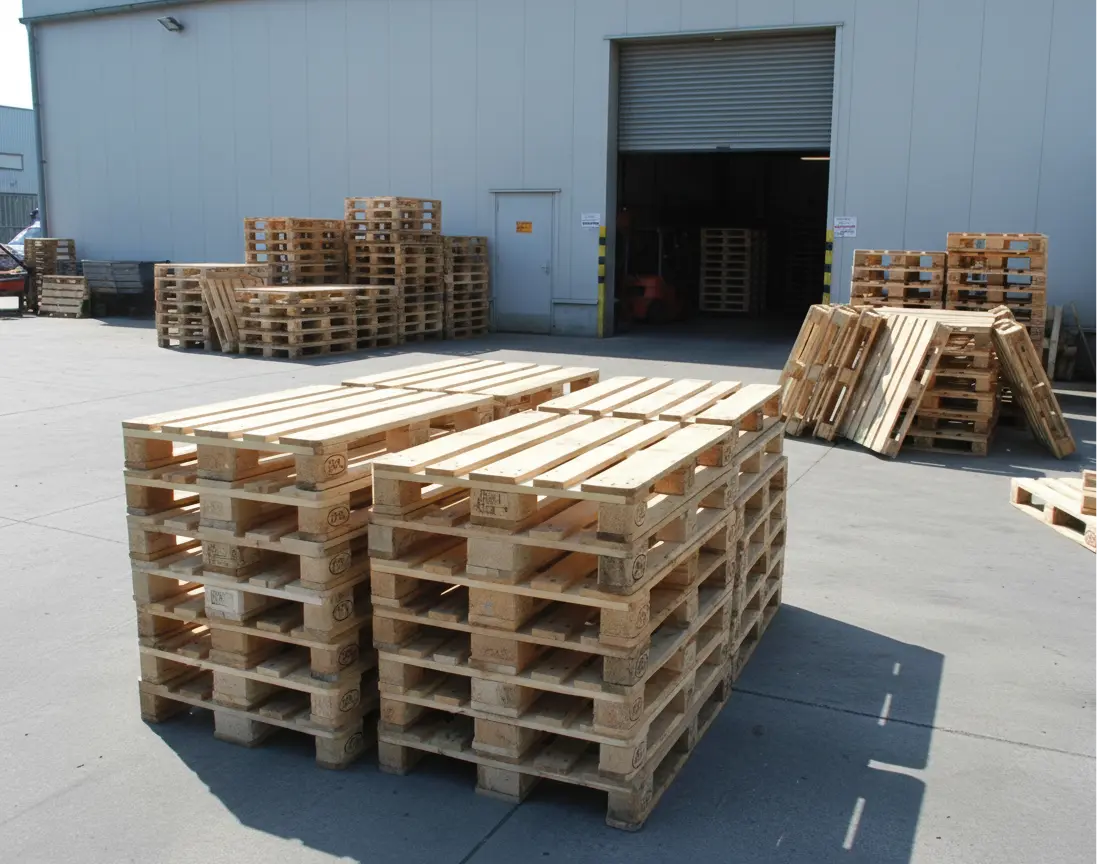

How does the purchase of euro pallets work?
Euro pallets are used daily in almost every production, trade and logistics company. Over time, however, large stocks accumulate — as a result of seasonal fluctuations, restructuring, damaged loading equipment or simply due to continuous incoming goods. Many companies do not know that these pallets have a real residual value and can be purchased professionally.
A structured purchase offers several advantages: Companies reduce their inventory, create space in logistics and at the same time receive fair compensation for materials that would otherwise get in the way unused. This creates a clearly measurable economic advantage, especially with larger quantities. The purchase also helps to close the pallet cycle sustainably — because many pallets can be repaired, reused or recycled instead of being disposed of.
Which pallets can be sold? (Quality Classes & Requirements)
For the Purchase of euro pallets The condition is decisive. Depending on use and visual impression, pallets are divided into four quality classes: New, A, B and C. This classification ensures transparency — both when pricing and when reusing or repairing them later on.
1. New euro pallets (“new” class)
New EPAL pallets are brand-new, unused and meet all technical and optical standards.
They are bright, free from damage and suitable for demanding industries.
Features:
- Unused, light wood
- No stains, damage or signs of wear
- Maximum stability
- Ideal for food, pharmaceutical and export logistics
Purchase:
New goods are mainly purchased in stores, but are purchased when excess stocks are available.
2nd Euro Pallet Quality Class A
A-pallets are used but very well-preserved euro pallets. They look well-maintained and are structurally flawless — visually almost like new.
Features:
- Brightly sorted, clean, no rough stains
- Completely Intact, No Loose Boards or Blocks
- All EPAL license plates are clearly visible
- Technically fully operational
Deployment:
Ideal for companies with high quality requirements, such as food, export or retail logistics.
Purchase:
Achieves the highest price among used pallets.
3rd Euro Pallet Quality Class B
B-pallets are used and show normal signs of use, but remain fully functional and replaceable.
Features:
- light/dark unsorted, slight discolouration allowed
- Technically stable, no structural damage
- EPAL markings easy to read
Deployment:
Good pallets for standard operations for storage, production and internal transport.
Purchase:
Very common purchase class, good value for money.
4th Euro Pallet Quality Class C
C-pallets have already been used several times and are visually more worn out, but are still usable and replaceable.
Features:
- severe discoloration and signs of wear
- Free from gross damage
- At least one EPAL stamp can be seen
Deployment:
Ideal for simple transport tasks, storage or as a basis for repair in Pallet trade.
Purchase:
Priced at the low end.
How does the purchase process work step by step? (Short & clear)
The purchase of euro pallets follows a simple, clearly structured process. These results in fast, transparent and predictable processing for companies.
1. Request & quantity
At the beginning, a short request is made with:
- Quantity of pallets
- Location
- Quality information (if known)
Photos can speed up the assessment.
2. Evaluation of pallets
The pallets are assessed either by photo or on site. The following is checked:
- What is the quality class?
- Are the pallets exchangeable or repairable?
- Are EPAL license plates available?
This evaluation forms the basis for the price calculation.
3. Price calculation and offer
Based on the status, a transparent offer is created.
The following are taken into account:
- Quality classes
- Current market prices
- Quantity scales
- Transportation costs
The customer receives a clear unit and total price.
4. Make an appointment
After acceptance of the offer, a pick-up or delivery date is agreed — quickly, flexibly and can be planned.
5. Pick-up or delivery
Pick-up: The truck picks up the pallets directly from the customer.
Delivery: Alternatively, the customer brings the goods by himself.
After the final quantity check, payment will be made in accordance with the agreement.
What prices are paid for the purchase?
The purchase prices for euro pallets result from several influencing factors and can fluctuate depending on the market situation. First and foremost, the condition of the pallets is decisive. A-pallets fetch the highest prices because they are visually and technically almost as good as new. B-pallets are in the mid-price range because although they show signs of use, they are fully functional and replaceable. C-pallets are rated the lowest in terms of price, but they are still useful and can be repaired frequently or used for simple transport tasks. On the other hand, pallets that are severely damaged or do not comply with EPAL usually cannot be reimbursed.
In addition to the condition, the quantity also plays an important role. The larger the inventory and the better the pallets can be bundled, the more attractive the prices are. Large volumes significantly reduce logistics costs per pallet and in many cases enable special conditions, especially when collections take place regularly or entire truckloads are available. This is why industrial and commercial companies with high circulation figures in particular benefit from better purchase prices.
Another influencing factor is the location of the pallets. If the pallets are close to a transshipment point or a regional hub, transport costs are lower, which has a positive effect on the purchase price. The shorter the transport routes, the more of the total value can be passed on to the seller.
The general market situation also plays an important role. Timber prices, availability on the pallet market and seasonal peak periods can influence remuneration. In logistic-intensive phases such as Christmas shopping, prices often rise, while excess capacity is more likely to lead to lower purchase prices. Professional buyers are constantly adapting their pricing structures to these market movements so that companies always receive fair and market-oriented offers.
Sample prices & quantity scales
Typical quantity scales:
- less than 100 pieces → standard prices
- 100-500 pieces → better conditions
- From 500 pieces → individually negotiable maximum prices
How is payment made?
When buying euro pallets, payment varies depending on the provider and is not always immediate. After the final quantity check, the agreed amount is usually paid out by bank transfer, occasionally as a credit note. In practice, however, payments may not be made on the same day and may take several working days, depending on internal processes. Delays or unclear processes cannot be ruled out, especially with less established buyers, which is why companies should pay close attention to payment modalities.
Payment in the Case of a Pallet Pool
Pallet pool transfers the full amount immediately after collection is completed — without waiting and without delays. As an established and certified logistics partner, we have a Creditreform credit score of 163, which underlines our financial stability and reliability. For companies, this means: fair prices, guaranteed rapid liquidity and consistently transparent, trustworthy processing.
Common mistakes when selling — and how to avoid them
When selling euro pallets, there are often avoidable mistakes that affect the achievable price or process. Many companies do not sort their pallets by quality class, which makes evaluation difficult and can result in lower offers. Missing or unreadable EPAL license plates also often mean that pallets are not reimbursed. Another common mistake is using unsuitable pallets for their intended purpose — such as heavily worn C-pallets for export or high-bay warehouses. Anyone who pre-sorts pallets cleanly, documents visible damage and ensures correct markings avoids misunderstandings and receives significantly faster and more transparent processing.
FAQ — Purchase of euro pallets
1. Which euro pallets can I sell?
In principle, you can sell EPAL pallets in classes A, B and C. More severely damaged or not EPAL-certified pallets are usually not recyclable.
2. How are pallets rated?
The evaluation is based on condition, EPAL stamp, signs of wear and repairability. The better the quality, the higher the achievable price.
3. Do I have to sort the pallets before selling?
Pre-sorting is not mandatory, but speeds up the evaluation and often leads to better prices, as there are clear quantities per class.
4. How fast is payment?
This varies depending on the buyer. With Pallet Pool, the Transfer is made immediately after collection; other providers often take several days.
5. Can I also sell small quantities?
Yes, but small quantities are often cheaper. Larger quantities or group loads enable better conditions.
6. What happens with damaged pallets?
Repairable pallets are repaired and returned to circulation. Heavily damaged or soiled pallets are not purchased.
7. Do I need to prepare anything for collection?
It is sufficient to make the pallets easily accessible and stackable. The driver will take care of everything else when you pick them up.
8. Can pallets be delivered?
Yes, many retailers — including a pallet pool — offer both pickup and delivery.
9. Can I with you too Buy euro pallets?
Yes, of course. Pallet Pool not only sells euro pallets in all quality levels, but also has a wide range of loading equipment available directly from stock. These include:
- H1 pallets
- E1 and E2 boxes (meat crates)
- mesh boxes
- wooden attachment frame
All products are available in large quantities and can be purchased ex factory, including delivery or in exchange, as required.

