


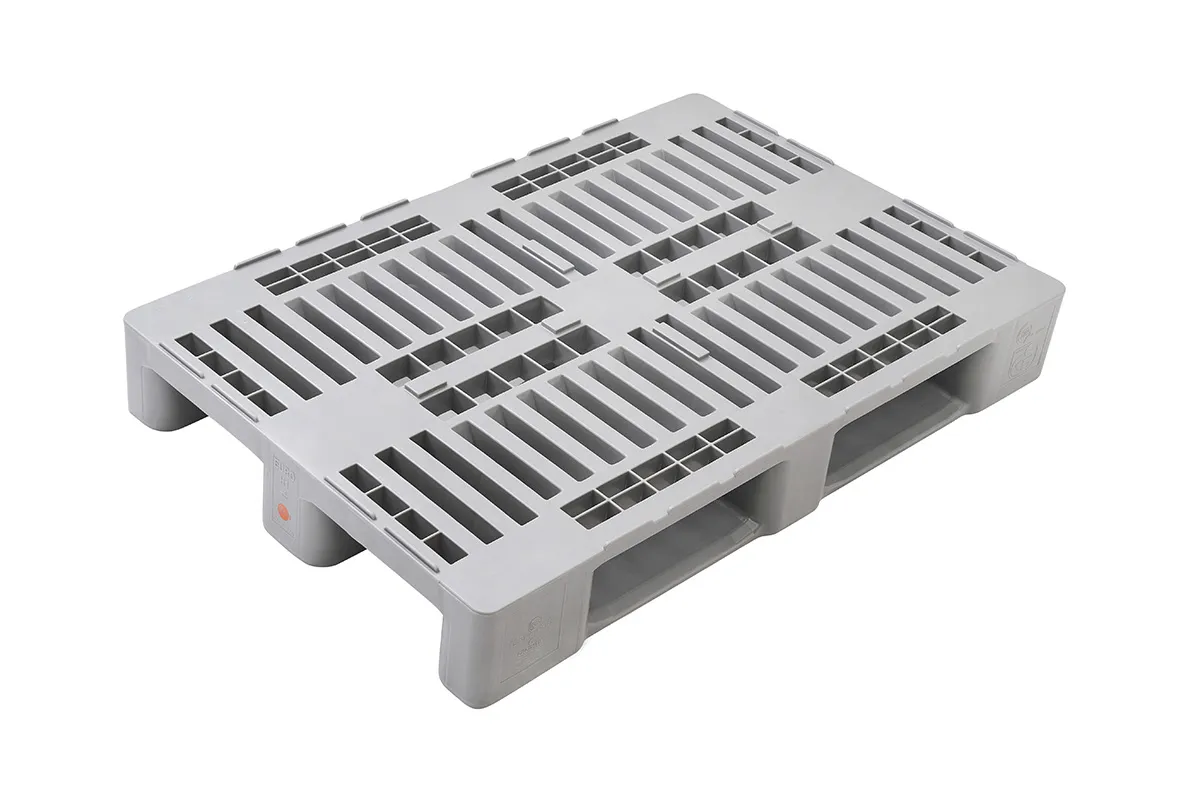

What are the dimensions of H1 pallets? Size, weight, and load capacity
H1 pallets are among the most important load carriers in food, meat, and hygiene logistics. Their dimensions are standardized, allowing them to be easily integrated into existing storage, transport, and reusable systems.
Nevertheless, questions often arise in practice: Exactly how big is an H1 pallet? How much does it weigh? And what loads can it handle in storage, during transport, or in high-bay racking?
The short answer: A standardized EURO H1 hygiene pallet measures 1,200 × 800 × 160 millimeters and weighs around 18 kilograms. However, when it comes to load capacity, a distinction must be made between nominal load, static load, dynamic load, and high-bay racking load.
The standardized dimensions of an H1 pallet
The external dimensions of a EURO H1 hygiene pallet are:
- Length: 1,200 millimeters
- Width: 800 millimeters
- Height: 160 millimeters
This gives the H1 pallet the same footprint as a classic Euro pallet. The base dimension of 1,200 × 800 millimeters facilitates integration into existing conveyor technology, truck loading spaces, racking systems, and standardized packaging processes.
Only minor dimensional tolerances apply to length and width. Minimal deviations are also provided for the height. These strict specifications ensure that H1 pallets from various approved manufacturers remain compatible with one another.
As a result, they can be reliably stacked, exchanged, transported, and used in automated logistics systems.
Why is the base dimension 1,200 × 800 millimeters?
The base dimensions correspond to the European pallet format, making them particularly practical for many logistics processes. Storage bays, roller conveyors, forklifts, pallet jacks, and loading areas are frequently designed to accommodate these dimensions.
As a result, companies can often use H1 pallets without having to fundamentally change their existing infrastructure.
The uniform footprint also offers advantages for transport. Pallets can be arranged in trucks according to fixed loading patterns. This allows for better planning of available space and ensures the most efficient use possible.
The number of H1 pallets that can actually fit into a vehicle depends on factors such as the vehicle type, the permissible stacking height, and the specific pallet design.
How high are H1 pallets and are they stackable?
The standardized height of an H1 pallet is 160 millimeters. The design typically includes three runners and allows for four-way entry.
This allows the pallet to be picked up from different directions using standard industrial trucks. This simplifies handling in the warehouse, during loading and unloading, and within automated conveyor systems.
For safe empty stacking, H1 pallets feature defined locking mechanisms and stacking aids. These ensure that the individual pallets fit together securely and are less likely to shift within the stack.
A stack of empty pallets can often consist of up to 26 units. In practice, however, the actual stacking height chosen depends on several factors.
These include the available storage height, the vehicle type, load securing requirements, and the internal safety guidelines of the respective company.
How much does an H1 pallet weigh?
The standardized tare weight of a EURO H1 hygiene pallet is approximately 18 kilograms. The dead weight therefore remains within a very narrow range.
This uniform weight is particularly advantageous for automated systems and recurring logistics processes. It allows the total weight of a load to be calculated with relative reliability.
Conveyor technology, scales, and automated picking processes can also be designed based on largely consistent values.
For products that are similar in construction but do not fully meet the official EURO H1 requirement profile, weight and height may vary.
For example, there are plastic pallets on the market with the same footprint but a different overall height or a lower dead weight.
Therefore, one should not rely solely on the product name. The specific product specifications, labeling, and approval for the intended area of application are what truly matter.
What is the load capacity of an H1 pallet?
Load capacity values vary because a pallet is subjected to different stresses depending on how it is used.
A load resting steadily on a flat surface puts different demands on the load carrier than a load being moved by a forklift or supported at only two points in a high-bay rack.
For a standardized EURO H1 hygienic pallet, a nominal load of 850 kilograms is generally specified.
Under certain conditions, an H1 pallet can be loaded with up to 1,000 kilograms in a high-bay rack. For this to be possible, the pallet must be positioned correctly and loaded evenly with self-supporting goods.
With uneven load distribution, the actual permissible load can be significantly lower.
Manufacturers often provide the following additional guidelines for specific H1 pallets:
- Static load capacity: up to 5,000 kilograms
- Dynamic load capacity: up to 1,250 kilograms
- High-bay racking load capacity: up to 1,000 kilograms
However, these values cannot be automatically applied to every H1 pallet or every plastic pallet.
The actual load-bearing capacity depends on factors such as temperature, load distribution, duration of the load, the condition of the pallet, and the type of support.
Therefore, the manufacturer's technical specifications and the requirements of the specific application area are always the decisive factors.
Static, dynamic, and high-bay racking loads explained
The static load capacity describes the load on a pallet when it is fully and steadily resting on a level surface.
Since the load is distributed across the entire underside and there is no movement, this value is usually the highest.
The dynamic load capacity applies when the loaded pallet is lifted and moved using a forklift or pallet jack.
During transport, additional forces act on the runners, deck, and load. The permissible load is therefore lower than for a pallet stored in a static position.
For the high-rack load the pallet often rests on only two rack beams. As a result, the center area is not fully supported and may sag under load.
For this reason, the condition of the pallet, the load distribution, and the precise positioning are particularly important when used in high-rack storage.
A high static load capacity therefore does not automatically mean that the same load is permissible during transport or in high-rack storage.
What role do material and design play?
EURO H1 hygienic pallets are made of plastic and are specifically designed for hygienically demanding reusable processes.
The closed and largely flat surface is easier to clean than the surface of many wooden pallets. At the same time, the material does not absorb moisture.
Cavities and structural recesses are designed so that, when used as intended, water does not collect in them.
This is particularly important in the food and meat industry. Contamination must be easily detectable, and pallets must be able to be cleaned or disinfected regularly.
Furthermore, H1 pallets are compatible with standardized E-crates or E-boxes. This allows food, meat, and transport containers to be securely arranged and stacked on the pallet.
The robust construction also allows for many cycles within a reusable system.
How do you identify a standardized EURO H1 pallet?
Not every gray plastic pallet measuring 1,200 × 800 millimeters is automatically an exchangeable EURO H1 hygienic pallet.
An approved pallet features specific markings. These include, among others:
- the GS1 logo or, on older pallets, the EHI logo
- a registration number
- the manufacturer's mark
- the tare weight specification
- the nominal load specification
- the designation as a EURO H1 hygienic pallet
The registration number allows the pallet to be traced back to a manufacturer and the specific production tool used.
Older H1 pallets with EHI markings may also still be in circulation and can be used within appropriate systems.
When purchasing used H1 pallets, you should therefore check that the necessary markings are present and legible.
Why are precise dimensions important when purchasing?
When buying used or new H1 pallets, you should look beyond just the general pallet type.
Even minor deviations can cause problems with automated systems, stacking systems, E-crates, or high-bay racking.
In addition, you should check the runners, locking mechanisms, deck, markings, and the actual dead weight.
Damaged or severely deformed pallets can lose their original load-bearing capacity, even if the model is generally rated for high loads.
Companies should therefore clarify before purchasing whether the H1 pallets on offer meet the official requirements, are approved for the intended load, and are in suitable condition.
This is particularly important for heavy loads, automated conveyor lines, and use in high-bay racking.
Conclusion: H1 pallets have a clearly defined standard size
A standardized EURO H1 hygienic pallet measures 1,200 × 800 × 160 millimeters and weighs approximately 18 kilograms.
The standard nominal load is 850 kilograms. Under certain conditions, loads of up to 1,000 kilograms are possible in high-bay racking.
Some manufacturer specifications also state static load capacities of up to 5,000 kilograms and dynamic load capacities of up to 1,250 kilograms.
In practice, it is crucial not to confuse the different types of load capacities.
Dimensions, labeling, condition, load distribution, and the operating environment must always be considered together.
This ensures that H1 pallets can be used reliably in transport, storage, and hygienically sensitive reusable processes.
Frequently asked questions about H1 pallet dimensions
What are the dimensions of an H1 pallet?
A standardized EURO H1 hygienic pallet has dimensions of 1,200 × 800 × 160 millimeters. Its footprint therefore corresponds to the format of a classic Euro pallet.
How much does an H1 pallet weigh?
The dead weight of a standardized H1 pallet is approximately 18 kilograms. Depending on the manufacturer, design, and version, similar plastic pallets may have a slightly different weight.
What is the load capacity of an H1 pallet?
The nominal load of a EURO H1 hygienic pallet is generally 850 kilograms. Under certain conditions, the permissible load in high-bay racking can be up to 1,000 kilograms .
What is the difference between static and dynamic load capacity?
The static load capacity applies when the pallet is stationary and resting fully on a level surface. In contrast, the dynamic load capacity describes the permissible load when lifting and transporting with a pallet jack or forklift. It is therefore usually lower.
Do H1 pallets have the same dimensions as Euro pallets?
The footprint is identical at 1,200 × 800 millimeters . However, at around 160 millimeters, an H1 pallet is slightly taller than a classic wooden Euro pallet.
How many H1 pallets can be stacked on top of each other?
When stacking empty pallets, it is common to group up to 26 H1 pallets into a single stack. The actual stack height possible, however, depends on the storage height, the transport vehicle, and load securing requirements.
Are all 1,200 × 800 millimeter plastic pallets H1 pallets?
No. Dimensions alone are not enough to classify a pallet as a EURO H1 hygienic pallet. A standardized H1 pallet must, among other things, feature the appropriate GS1 or EHI marking, an approval number, and defined technical specifications.
Interested in H1 pallets? Buy H1 pallets now.

