



What are the dimensions of E2 crates? Size, weight, and volume
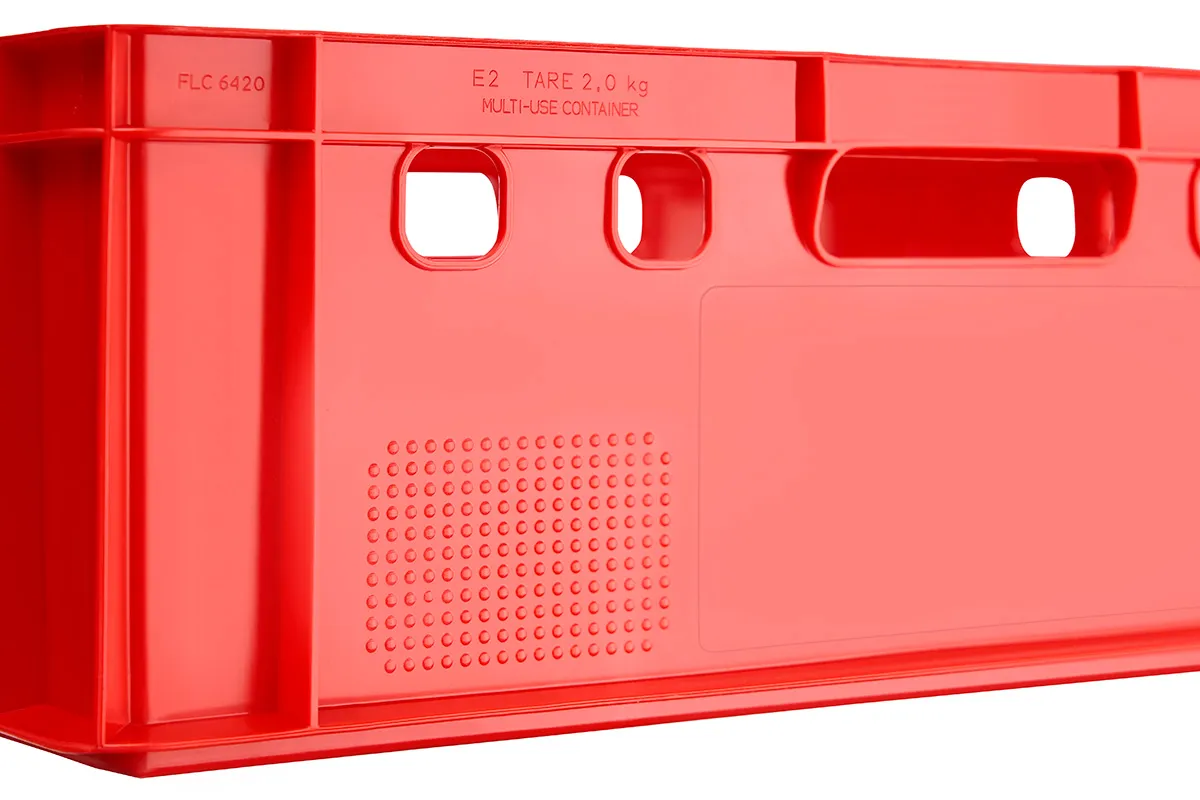
E2 crates are among the most widely used reusable containers in the food industry. They are used primarily in butcher shops, slaughterhouses, commercial kitchens, and food retail for the storage and transport of meat, sausages, and other perishable products.
To ensure E2 crates can be easily stacked, transported, and used in automated logistics systems, they have a largely standardized base size. However, there may be slight variations in internal dimensions, weight, and actual usable volume depending on the manufacturer and specific design.
This article outlines the dimensions of E2 crates, how much they weigh, and the storage volume they provide.
E2 crate dimensions at a glance
The typical technical specifications for an E2 crate are:
The uniform external dimension of 600 × 400 × 200 mm corresponds to the European base size for many standardized transport and storage containers. E2 meat crates are manufactured according to requirements including DIN 55423.
What are the external dimensions of an E2 crate?
A standard E2 crate has the following external dimensions:
600 × 400 × 200 mm – length × width × height
Converted, this equals:
- 60 cm length
- 40 cm width
- 20 cm height
These dimensions are identical for most E2 crates. As a result, containers from different manufacturers can often be stacked together and integrated into existing logistics processes.
The base size of 600 × 400 mm is also designed to fit the dimensions of a Euro pallet. A Euro pallet measures 1,200 × 800 mm. This means four E2 crates can be placed on a single pallet layer: two crates along the length and two along the width.
This standardized footprint facilitates transport, reduces wasted cargo space, and enables predictable inventory management.
What are the internal dimensions of E2 crates?
While the external dimensions are largely standardized, the internal dimensions can vary slightly depending on the manufacturer and design.
Typical internal dimensions include, for example:
- 565 × 365 × 195 mm
- 568 × 368 × 191 mm
- 570 × 370 × 195 mm
- 570 × 373 × 195 mm
For instance, WERIT specifies an internal dimension of 565 × 365 × 195 mm for an E2 meat crate. At Rotom, the internal dimension is 570 × 370 × 195 mm. A model from GIWA, on the other hand, has internal dimensions of 568 × 368 × 191 mm.
These differences arise due to factors such as:
- the thickness of the side walls,
- the design of the base,
- reinforcement ribs,
- the shape of the handles,
- the stacking rim,
- as well as the manufacturer's design specifications.
Anyone requiring E2 crates for a precisely defined product size, machine, or conveyor system should therefore not look at external dimensions alone. In such cases, the specific internal dimensions of the respective model are also crucial.
What is the volume of an E2 crate?
The stated volume of an E2 crate is usually around 40 litersMany manufacturers market their E2 containers as 40-liter crates.
Depending on the design, however, the actual usable volume may be slightly lower. For example, GIWA specifies a volume of 37 liters for an E2 meat crate.
Therefore, you can generally assume the following range for E2 crates:
Usable volume: approximately 37 to 40 liters
The theoretical volume based on the external dimensions would be larger:
60 cm × 40 cm × 20 cm = 48,000 cm³
This corresponds to 48 liters. However, this value only describes the external geometric space. Wall thickness, handles, reinforcements, stacking rims, and the slightly tapered shape of the container reduce the actual usable internal volume.
For practical planning, you should therefore always use the usable volume specified by the manufacturer.
How much does an E2 crate weigh?
The dead weight of an empty E2 crate is generally around 2 kg.
WERIT, Rotom, and GIWA all specify a weight of 2 kg for their respective E2 models.
The weight can vary slightly depending on the material, wall thickness, and design. Particularly robust models with additional reinforcements may be slightly heavier, while lighter versions may fall slightly below this value.
The dead weight is particularly important for calculating the total weight. For example, if an E2 crate is filled with 30 kg of goods, the total transport weight is approximately 32 kg.
The following applies:
Total weight = dead weight of the crate + weight of the contents
When handling manually, ergonomic and operational requirements should always be considered in addition to the technical load capacity.
What is the load capacity of an E2 crate?
The possible load depends on the specific model. For many E2 crates, a maximum filling weight of around 30 kg specified.
For example, GIWA specifies a filling weight of up to 30 kg and a stacking load of up to 500 kg for its E2 meat crate. A load capacity of 30 kg is also frequently specified for other standard models on the market.
Load capacity should not be confused with stacking load:
- The filling weight describes how heavy the contents of an individual crate may be.
- The stacking load describes the weight that can be applied to a crate when several filled containers are stacked on top of one another.
The actual permissible values may vary depending on the manufacturer, the condition of the crate, the temperature, and the type of load. For greater stacking heights or automated conveyor systems, the technical data for the respective product should therefore always be checked.
Why do E2 crates have standardized dimensions?
Standardized container dimensions create a uniform system for storage, transport, and processing.
The E2 format offers several advantages:
Efficient pallet utilization
Thanks to the 600 × 400 mm footprint, four E2 crates can be arranged on a 1,200 × 800 mm Euro pallet. This allows the available pallet area to be used without significant gaps.
Secure stackability
The continuous rim allows multiple E2 crates to be stacked securely on top of each other, which facilitates both storage and transport.
Use in automated systems
Uniform external dimensions are particularly important for roller conveyors, conveyor systems, washing systems, and automated storage technology. Many E2 crates are specifically designed for both manual handling and automated conveyor technology.
Compatibility with other containers
The Euronorm base dimension allows for combination with other container sizes based on a 600 × 400 mm grid or corresponding fractional dimensions.
What material are E2 crates made of?
E2 crates are primarily manufactured from high-density polyethylene, or HDPE for short. This material is stable, impact-resistant, moisture-resistant, and relatively easy to clean.
Typical E2 meat crates feature:
- a solid base,
- solid side walls,
- open hand grips,
- smooth, easy-to-clean surfaces,
- and a sturdy stacking rim.
Many versions are intended for direct contact with food and are designed to meet the requirements of professional cleaning and washing processes.
For hygienically sensitive applications, you should verify before purchasing that the crates are food-safe and comply with the necessary standards and operational requirements.
What is the difference between E1, E2, and E3 crates?
E1, E2, and E3 crates typically share the same 600 × 400 mm footprint. The main difference lies in their height and, consequently, their available volume.
Typical sizes are:
The E2 crate therefore represents the medium size. It offers more volume than an E1 crate, yet remains more compact and lighter than an E3 crate when loaded with the same density.
Which version is suitable depends primarily on the goods, the desired filling weight, transport routes, and existing storage or conveyor systems.
What should you look for when buying E2 crates?
Although the external dimensions are largely uniform, E2 crates differ in other technical specifications.
Before purchasing, you should check the following points in particular:
- precise internal dimensions,
- actual usable volume,
- dead weight,
- permissible load capacity,
- maximum stacking load,
- material and food safety,
- temperature resistance,
- suitability for automated washing systems,
- compatibility with existing conveyor systems,
- labeling options,
- condition of used crates.
For simple transport tasks, standard off-the-shelf models are often sufficient. However, in automated or highly hygiene-sensitive processes, a difference of a few millimeters or a different base design can be significant.
Conclusion: What are the dimensions of E2 crates?
A standard E2 crate has external dimensions of 600 × 400 × 200 mm. Depending on the manufacturer, the internal dimensions are approximately between 565 and 570 mm in length, 365 and 373 mm wide and 191 and 195 mm high.
The dead weight is usually around 2 kg. Depending on the model, the volume is stated as approximately 37 to 40 liters . Many E2 crates can be filled with up to 30 kg , although the specific manufacturer specifications are the deciding factor.
Thanks to their standardized footprint, E2 crates can be arranged on Euro pallets to save space, stacked securely, and integrated into numerous manual or automated logistics processes. This makes them one of the most important reusable containers in the meat and food industry.
FAQ about E2 crates
What are the dimensions of an E2 crate?
An E2 crate usually has external dimensions of 600 × 400 × 200 mm.
What is the volume of an E2 crate?
Depending on the manufacturer and design, the usable volume is approximately 37 to 40 liters.
How much does an empty E2 crate weigh?
The dead weight of an E2 crate is generally around 2 kg.
What is the maximum load capacity?
Many E2 crates can be filled with up to 30 kg of goods. The manufacturer's specifications are authoritative.
What material are E2 crates made of?
E2 crates are usually made of robust and easy-to-clean HDPE plastic .
How many E2 crates fit on a Euro pallet?
A 1,200 × 800 mm Euro pallet can hold four E2 cratesper layer.
What is the difference between E1, E2, and E3 crates?
The crates usually have the same footprint of 600 × 400 mm, but differ in height and volume. E2 crates represent the medium size.

